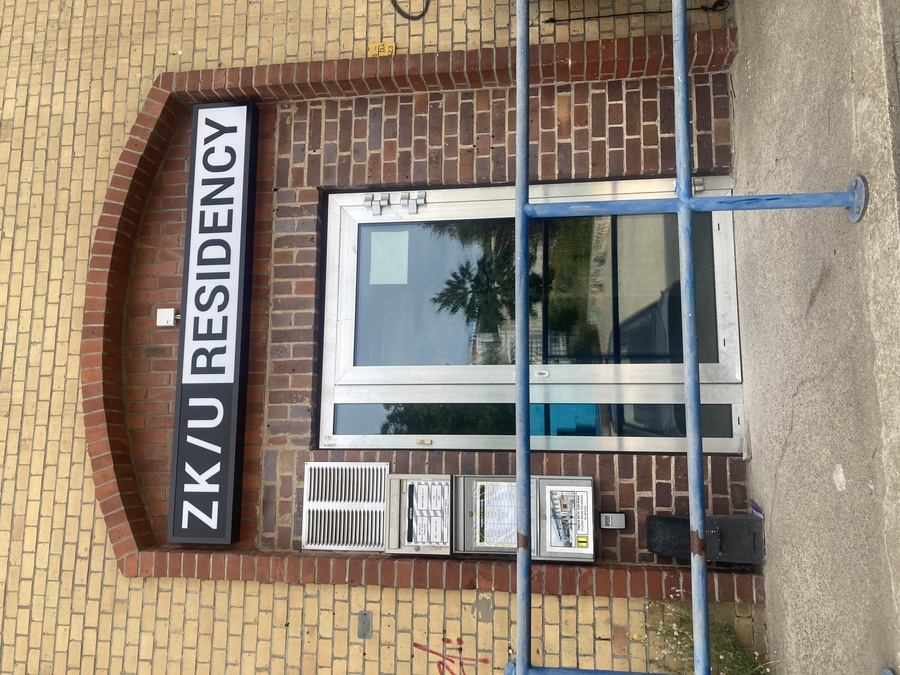
This summer I participated in my second artist-in-residency at the Zentrum für Kunst und Urbanistik / Center for Art and Urbanistics, affectionately called ZK/U, in the Moabit neighborhood of Berlin, Germany. I’m writing this up as self-reflection but also because I think it helps to show what I’m working on, my community / “scene”, and I enjoy reading these kinds of reflections and write-ups by other media artists, such as blogposts by Antonio Roberts on conferences, residencies and exhibits.
Last year I spent 4 months in residency at ZK/U as well, during my fall 2026 sabbatical, so I was already familiar with its staff and community. In the fall I worked primarily on the L5 creative coding library, which I’m now using to make the majority of my work, and other people are contributing to and using to make interactive art on the computer. In this post I’ll concentrate on my residency this summer.
ZK/U is a special place, basically an alternative artist/cultural space, a non-commercial space specifically. They describe themselves as “production site, artist/research-residency, program platform. In our work we connect local practice and global discourse.” There is live/work studios for about 14 international artists, along with a connected building with concert/venue, bar, meeting rooms, and a rooftop space. It is surrounded by a public park with gardens, playground, meeting space, and a DIY tiny home. There are also a large number of public events, from documentary film screenings to concerts to community fleamarkets and bike swapmeets.
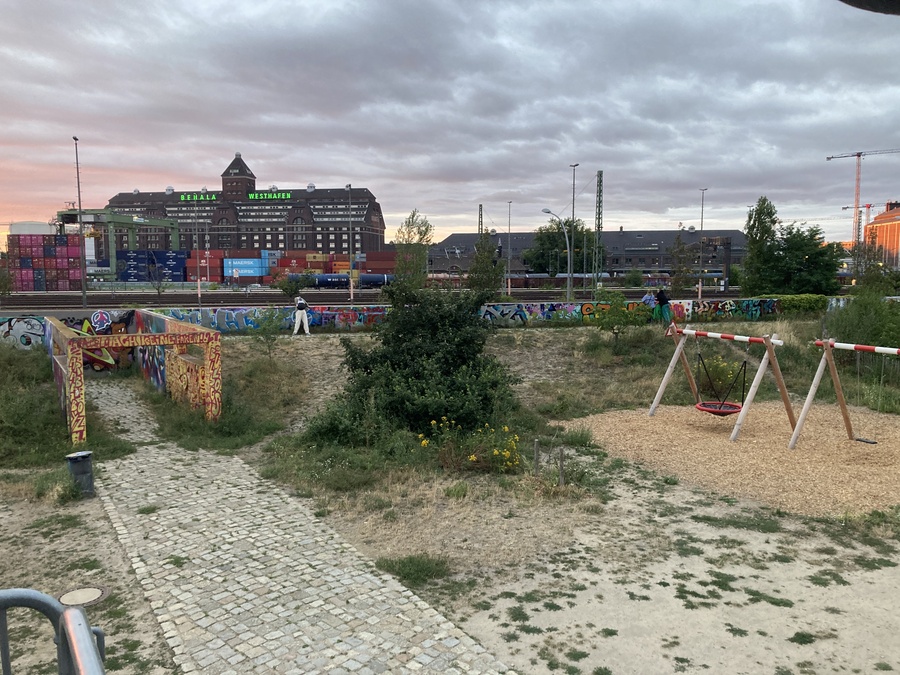
The residency building is an old railroad freight station. The rooms are large. There is a generous back deck. Artists aren’t specifically working on any one thing per se, but everyone seems to be aligned with the idea of city as site, and there are various strains of a focus on community, activism or socially-engaged practices that seems to underlie many of the participating artists.
Every other month there are public open studios, which is the main public program for presenting the work of the artists in residence there. This is an open format, less daunting than an exhibit as it frames the work shown as “work-in-progress”, a good way to show the work of artists, how they work, and allow experiments to happen.
In this particular residency period I had two goals: to work on experimental sound art and performance, as well as to make several new media artworks to present publicly.
Performance and sound art
In terms of music, I brought my eurorack modular synthesizer, as well as a relatively new to me, and new invention to the world, a woodwind instrument called the Alto Venova, made by Yamaha. It’s a bit like a cross between a sax/clarinet and a recorder. It is made of ABS plastic, and uses an alto saxophone mouthpiece. I used to play clarinet, bass clarinet and bassoon in band, wind ensemble, a lab jazz ensemble, and most importantly to me, in an experimental improvisatory ensemble. In high school I began to experiment with electronic music production on the computer, and in undergraduate courses I studied electracoustic music production (along with music composition, opera, and other classes) as part of my studies. The Alto Venova is described by Yamaha as a new casual wind instrument, which I purchased because I wanted to experiment with playing a woodwind instrument through my modular synth. I didn’t want to invest a ton of money into purchasing a new or used bass clarinet or bassoon, which go for hundreds if not thousands of dollars, and the Venova seemed like a much lower barrier entry point to experiment with. It’s also a lightweight, easily transportable instrument, which made it so much better for bringing it on tour with me, not just through airports but also on the subway with my synth when going between venues.
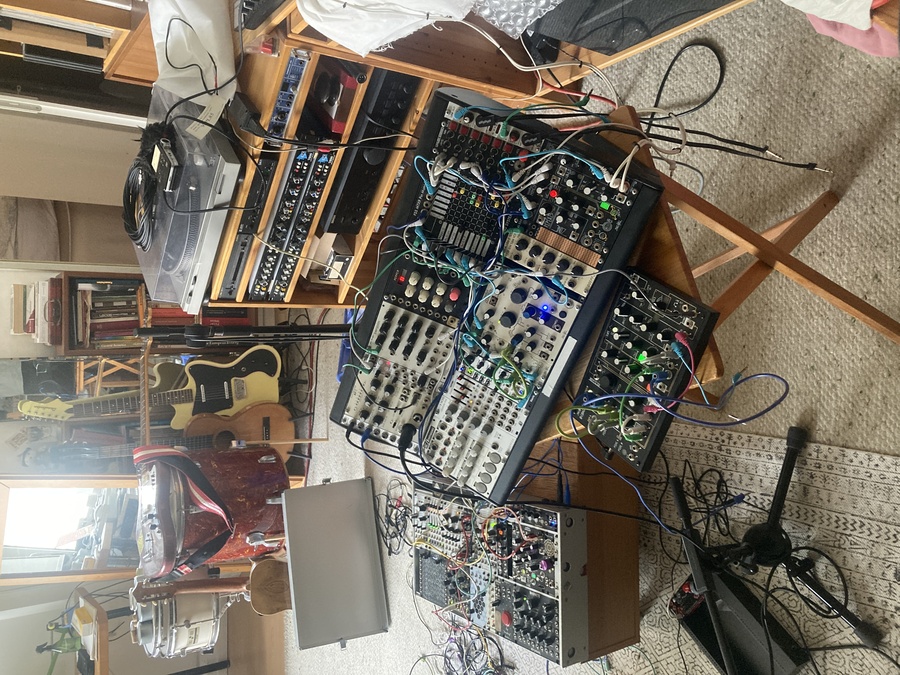
Lee and Janek’s synths recording setup at Echo Coordinate
In residency in addition to performing at the Openhaus program in July at ZK/U I also recorded music twice at Echo Coordinate with collaborator Janek, who DJs Biesentales for Berlin’s excellent Cashmere Radio station - we’re working on an album with this music; I played at recording studios with Pedalmarkt owner Andre and his collaborators, with keyboards, drums, bass, guitar and an Engyptian rapper; I recorded my own experiments during the Week of Patching. I also recorded music with my friend, composer Jonah Senzel. I participated in a workshop session with composer/musician Limpe Fuchs at recording studio / project space Morphine Raum. So it was a productive month! Recordings from sessions are intended to go up on my music website ExquisiteCorp.
I want to note Janek’s generosity as a musician and friend. He loaned me instruments and brainstormed and then helped repair my Intellijel eurorack case when it broke in the Vienna airport (!).
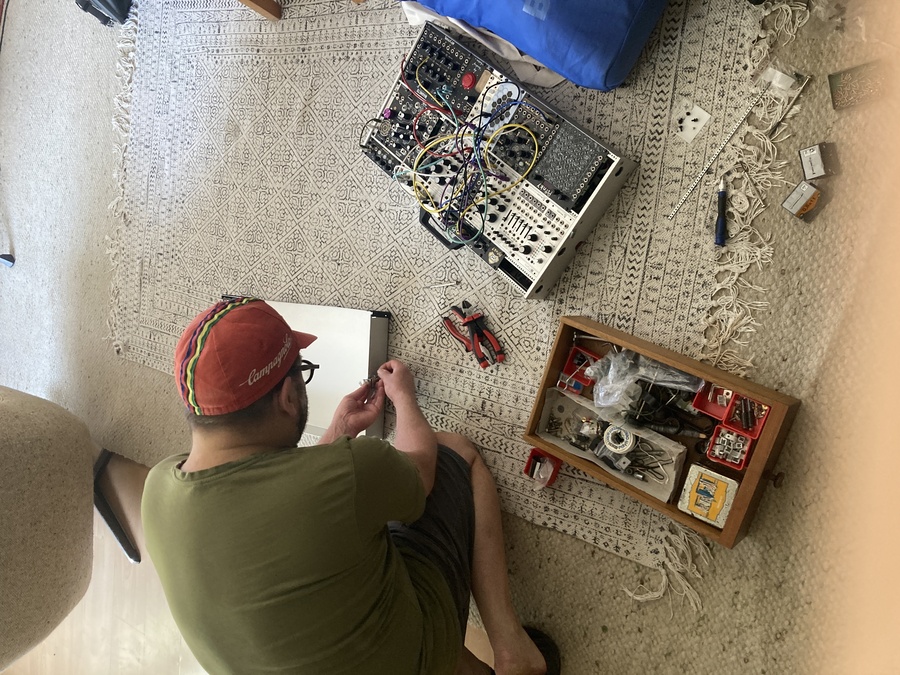
Janek repairs a latch on my intellijel case
Media artworks created in residency at ZK/U
I completed 2 1/2 works while in residency as well as taught a workshop.
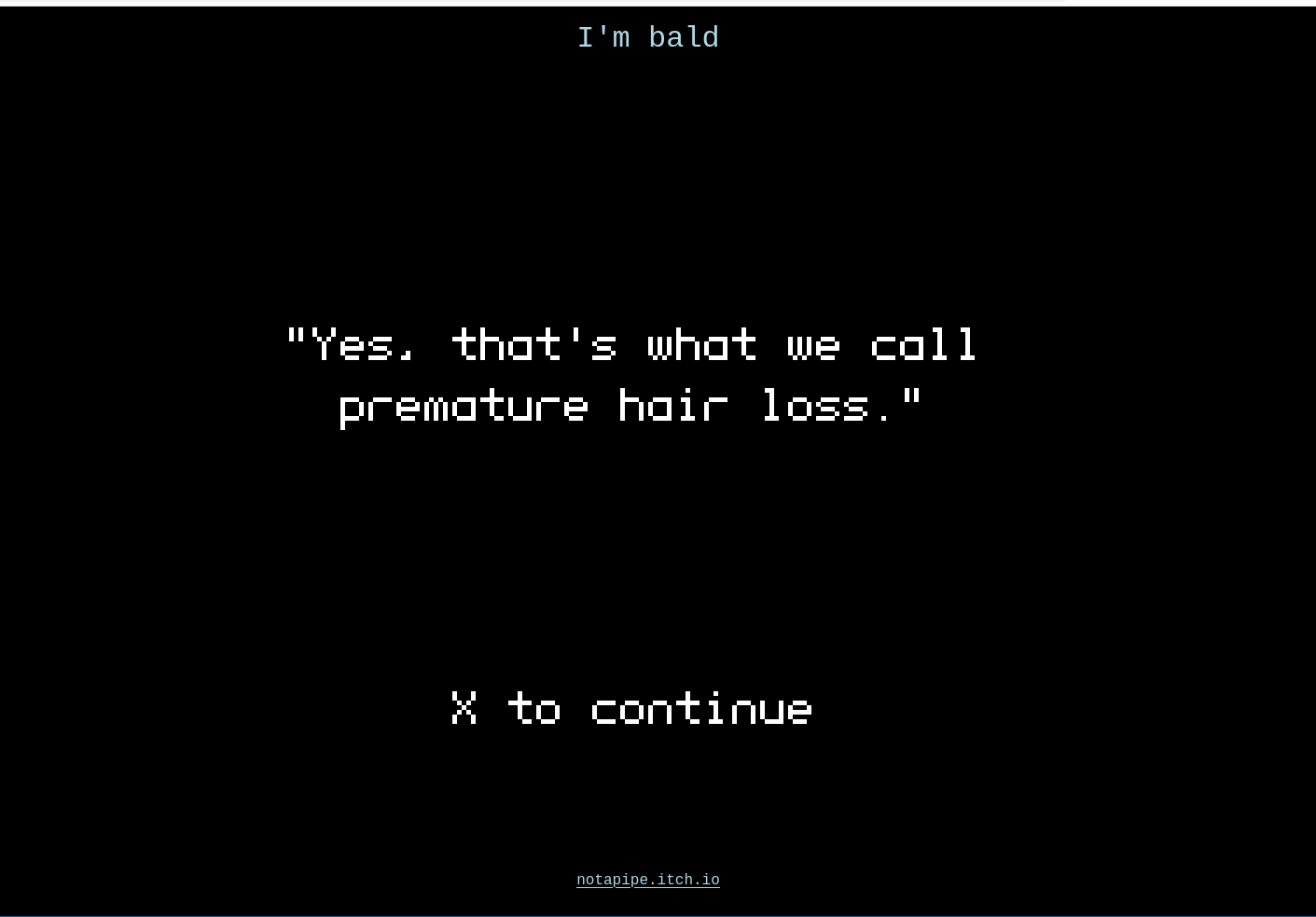
low resolution text in screenshot from I’m Bald that says “Yes, That’s What We Call Premature Hair Loss”
First, I made a game poem, a playable story consisting of an autobiographical account of losing my hair and coming to terms with it. I built this in puzzlescript, one of my favorite tools for making games and media art with a block-based, low-resolution approach. It’s a unique engine for building work, and this piece is short, about 2 minutes total to play. In it, there are intercut scenes that vary between short text passages and then a view of my head, with my hair programmatically disappearing. You advance through the narrative with spacebar or ‘x’ key, and essentially the player can only advance through the story, never resist or take an alternate path, just as you can never resist baldness, not really! This piece was submitted to Game Poems magazine.
The second work I created isn’t 100% finished yet but is close to done. It’s an updated approach to creating a playable virtual studio visit, which I first explored back in 2018. In this new incarnation, a riff on studio visits complete with a ‘wacky waving arm’ of the viewer, controlled by the mouse, a reference to the underlying obtuseness of the physical material of the human-computer interface and the kinds of ‘interaction’ made legible by creative coding libraries.
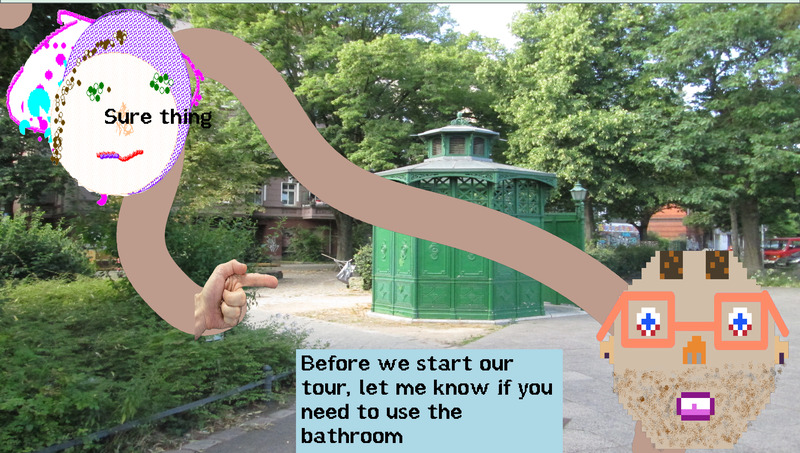
Work in-progress: A ‘virtual studio visit’ at ZK/U, created in L5
While the piece I think “works” right now, I may want to come back and tighten up the ending a bit, add hair back to the arm, possibly even add some branching sequences/forking paths. I’ll then add the work to my website after that.
This studio visit was created in the L5 creative coding library, which I initiated in summer 2025 and worked on extensively at ZK/U during my fall 2025 residency there. In the fall I taught a workshop with p5.js, as L5 wasn’t quite ready for the public then. You can read more about L5 development and the extension in a post on the new L5 development log.
Well I’m pleased to say that this spring I taught a beginner creative coding workshop in L5. It was fun to teach, and was the very first deployment of the new L5 extension for VS Code / VS Codium, showing that it is a viable beginner-friendly way to begin to learn creative coding.
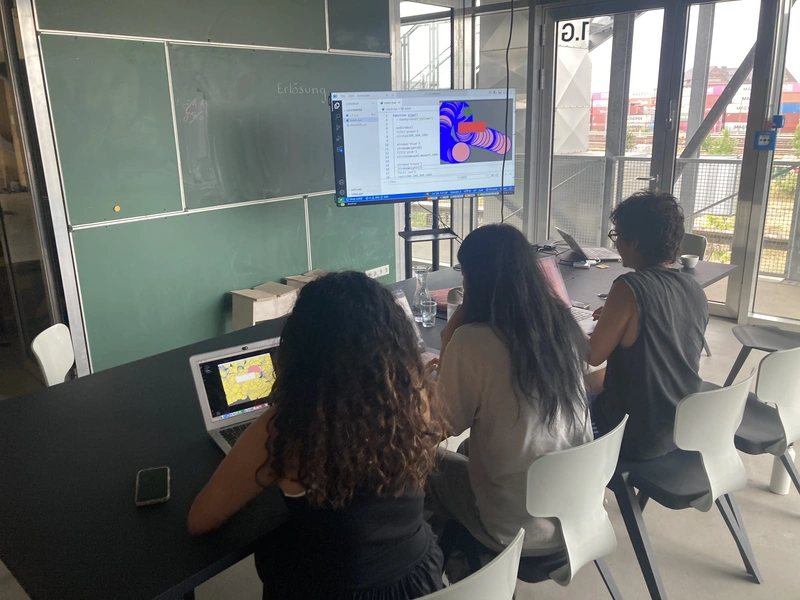
A L5 workshop at ZK/U showing 3 people coding on their laptops and a classroom monitor in front of them, showing code and geometric abstract works
While working on the studio visit piece I ran into a bug that I couldn’t solve alone when I was first working on this at the beginning of the month. I participated in the Berlin Creative Code Jam, which is organized by Raphael from Processing Foundation. I showed him my original studio visit from 2018, coded in p5.js, then my current attempt to port the arm and some underlying structure to L5. The arm was acting strange but not in a fun way. It took some time, but we realized the lack of default rounded strokecaps in L5 was what caused the issue, then showed me a single line of code to replace line-drawing with pill-drawing (rectangles with rounded edges), which I was able to use to fix that issue.
The second work I created I’m calling Easy Read / Hard Read.
Easy Read / Hard Read deals with the in/adequacy of language, prompted by my experience visiting German museums and the prevalence of easy read exhibition texts. I was particularly affected by their tone and attempts to convey meaning in different registers. Attempting to translate my journal notes into this form of a guide pulled against my desire to obscure personal information, which I imagined hidden in the form of a cant. In this work, the “easy read” is forefronted, literally in a layer of written text above my original text journal, which flashes by one word at a time underneath. A separate audio track serves as the hard read, consisting of the same texts translated into my own sampled vocalized rendition of morse code, which I can decipher and communicate in, itself a form of encoded information even though it can also be considered the simplest way to transmit information. This work is created in custom software written with L5, the creative coding library I initiated.
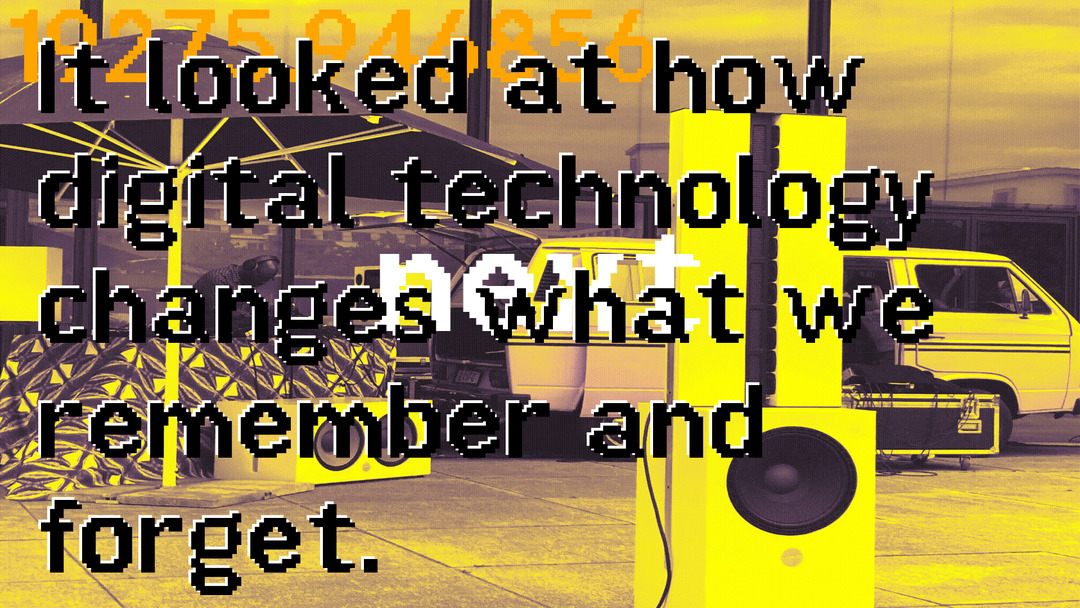
screenshot from artwork Easy Read / Hard Read, 2026
Easy Read / Hard Read is a programmatic work. I wrote it in L5, and unlike many of my other recent works, it does not use procedural generation, so it will always run the same way each time. It advances through my journal, showing the “easy read”, overlaid on the original text, with the morse code audio overlaid and my own music.
Among other goals, the L5 creative coding library is a response to ideas of permacomputing. I’ve designed the library to work even on older and lower-resourced machines. To this end, i borrowed my friend Janek’s 2012 Windows machine. I believe it may have been running Windows 8? It served as the brain powering both I’m bald as well as the interactive Studio visit at ZK/U works. My own personal 2019 laptop powered the Easy Read / Hard Read work.
Community
In addition to performing at the Openhaus and exhibiting my completed works and work-in-progress studio visit piece I really enjoyed working with the staff at ZK/U, especially organizer / curator Carola, and my fellow artists, curators and cultural workers in residency. I can’t name them all, but it was great to be able to talk and exchange ideas til the early hours of the morning.
I met throughout the summer, first in-person in NYC and later remotely from my travels in central europe then Berlin with collaborator Sam Heckle. Sam did so much great work on L5, not least of which is publishing the new L5 extension for VS Code and VSCodium. It was great to be able to work together.
In Berlin I’m so thankful for the great community of artists and musicians I’ve been able to work with there. In addition to the Openhaus at ZK/U, which several hundred people attended, I presented my works-in-progress at Show Us At Your Screens at Offline space; at the Open Projector with School for Poetic Computation at Trust Support; and at the Creative Code Jam, organized by Creative Code Berlin. Thanks as well to collaborators and friends Janek, Kit, Sarah, Andrey, Raphael, Arne, Wakest, Jack, Nina, past residents Mickey Phoenix, Camille, Chinendum, Siiri, Ella, Zzzelin, and many more.