You can listen to this album mix to accompany reading this post. ZK/U 1 by ExquisiteCorp, kuunsirpale and Ella Prokkola recorded live at ZK/U art residency, Berlin, DE 22 October 2025.
Later this year I’d like to put out a zine about No-Input Mixing Board Music. But I thought I could start with an introductory blog post! So here we are.
In the fall I was an artist-in-resident at ZK/U in Berlin - a really special artist-in-residency, where I live/worked with a dozen other artists from around the world. I worked on L5, a creative coding library in Lua, and created half a dozen artworks and installation using the coding library. In addition, I brought my modular synth with me and played some shows and jams around the city, and performed at Z/KU. Not long after I began the residency I visited the depths of the ‘gear closet’ and found an old Mackie mixer sitting around. A light went off in my head and I remembered: hey, this could work for no-input mixing board music. And I brought the mixer out of the basement and into my studio to work with it.
In some ways, writing about no-input mixing board feels like a ‘throwback’ because it became popular among experimental sound musicians about 20 or 15 years ago. And yet, this is a niche group, and I think the full depths of the instrument haven’t been fully explored. And at a time that so much gear and music subculture has been containerized and gear gets productized it feels like a ripe time for re-exploration of techniques and systems that work against products, planned obsolescence and proprietary usage. I am particularly on this wavelength recently as I think about permacomputing. More on that later.
What is the No-input mixing board instrument?
I don’t know if this will make sense to anyone else, but I think of the no-input mixing board as falling roughly between a synthesizer, a radio, a violin and a bank of buttons on an elevator.
The name “no-input” is misleading: there is input. Typically no-input mixing involves plugging an output from an analog mixing desk back into the mixer’s input so that the circuit forms a loop: an oscillator. Feedback transforms the controls on the mixer so that they modulate the sound output, which is what turns the mixer into a playable instrument. Audio feedback develops through this loop, with a large variety of sound textures possible as you continue to add more output to input routing on the mixer. The faders and knobs on the mixer allow for immediate playback manipulation - massively changing the sound.
The No-Input Mixing Board has been called the “poor man’s synthesizer,” but unfortunately I can’t remember where I heard that. You don’t need to buy half a dozen modules that cost hundreds of dollars. You can add effects pedals, but you don’t have to. Lots of people have old mixers sitting around, or you can find one in an organization or venue’s closet, or cheap-ish from used marketplaces.
Popularization of feedback mixing
The name “no-input feedback mixing” was popularized by Japanese musician Toshimaru Nakamura in the 90s, and abbreviated on his albums titled NIMB that he puts out solo or in collaboration with other musicians. But using feedback for music creation has had a place in electronic music for decades.
In the 1960s and 70s many musicians experimented with feeback-based music: Eliane Radigue, Pauline Oliveros, the Sonic Arts Union, Jaap Vink and others. Jimmy Hendrix popularized the use of feedback with guitar and pedals and pop-based music. Musicians in the jazz lineage (think of Miles Davis) experimented with feedback, echoes and effects as instrument in the studio. Other musicians experimented with removing the guitar from the effects chain. Most foundationally we can also point to the work of the pioneers of Jamaican dub music like King Tubby and Lee ‘Scratch’ Perry and many others that turned the work of mixing on a board into an instrument in its own right. We build from the work of all of these ancestors.
Visiting the Bandcamp website in 2026 and typing in no-input mixing board reveals dozens of albums recorded with solo musicians using the instrument/technique, and collaborations within various ensembles.
Techniques of the No-Input Mixing Board
There are a number of ways to ‘patch up’ the mixing board for playback. It’s very possible to watch video tutorials. Type ‘no-input mixing board’ into YouTube and dozens of tutorials pop up. That’s fine. But it’s also just as useful to just get the concept and try it yourself first.
WARNING 1: Before you try it out, be aware of one major issue: IT CAN GET LOUD. It can get dangerously loud for your ears, and volume changes can abruptly happen. For this reason, it’s recommended to add in a compressor / limiter (which is a piece of gear) between your output and your speakers. I do not recommend wearing headphones, particularly as you first work with the instrument. I know this from experience. Don’t blast your ears. It’s not worth it.
WARNING 2: Plugging the output of a mixer back into its input is a hack. It’s not the intended use of the mixer, and it’s possible you can damage it. I haven’t personally found I’ve damaged a mixer this way, but I wouldn’t do it on a friend’s nice borrowed mixer necessarily (although I have!). For this reason, many people use older mixers, even ones that have maybe a broken input on one channel for example. Maybe put another way: rather than buying something new, use old and discarded equipment and this will extend the life of forgotten hardware.
With our warnings out of the way: consider how the no-input mixer gets played. The EQ dials that would normally boost or attenuate different frequency bands can cause smooth or abrupt changes to pitch, timbre, rhythm, or more holistic behavioural changes. Similar to how with a modular synth you place a cable from one output to another, creating your own sound and effects chains, the no-input mixer allows you to design your own custom digital instrument of sorts. It’s typical to have many routings from outputs on the mixer to various inputs.
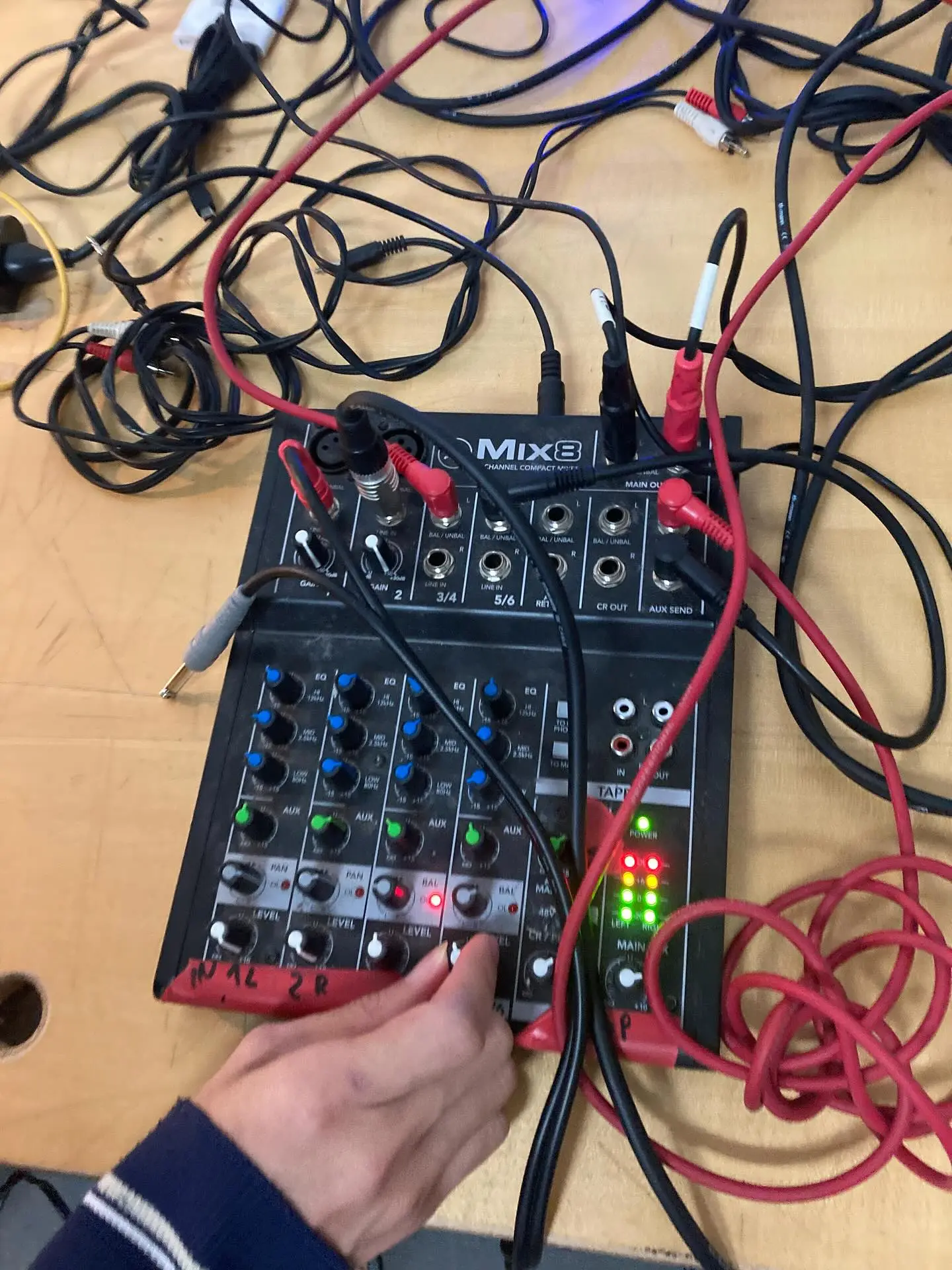
I got started with the Mackie Mix8 because that’s what I found at the residency basement. It has control room and tape outputs and effects sends outputs. With audio cables I routed them back into various mono and stereo inputs on the mixer. Of course you also need to route to some speakers. Then I ‘played’ the instrument by starting the volume low and pulling up til I could just hear it. I play the insrument by manipulating the EQ knobs on the channels, and adjusting the amount of signal sent to the effects sends, and by pulling up and down the various faders to control the amount of feedbacking sound and effects. Due to the strangeness of the outputs running to the inputs in a loop you get drastically varying and immediate audio feedback as you play. In fact, I think it feels much more immediate than a modular synth, and due to the chunkiness of the knobs and faders, it also has a nice feel in the hands. You really feel like you’re playing a wailing instrument. And coaxing or exorcising its demons.
No-input mixing and economy
There’s a great paper Musical Pathways Through the No-Input Mixer, consisting of analysis of interviews with musicians that work with this unique instrument.
I am more interested in using what is at hand, pre-made, used—that is to say cheap—than collecting expensive equipment, or reaching toward hip new modalities like AI that intersect with capitalism and digital surveillance –Mira Martin- Gray
“I liked this idea of getting rid of the screen and going analog and I just did not have the money for it… looking around my studio like what do I have? I have a mixing desk.” –Simon Grab
As I’ve been considering the lifecycle of our computer hardware lately I’ve reduced my consumption of new phones, computers and other hardwares. I’ve extended the life of my computers with Linux. I’ve extended the life of my phones by replacing batteries every couple years. For my hardware music, I consider the no-input mixer a timeless music system. It’s ugly. It’s sound is obtuse, or can be, but it can also be, if not a swiss army knife, an instrument with its own tone and timbres, yet one with enough variability that it can be played lifelong as an instrument. It may not be a violin, but it is equally worthy of play and experimentation. And its immediate tactile nature makes it very accessible, even for those without previous experience playing electronic instruments.
No Product
An advantage of repurposing pre-existing mass-produced mixers are that there is much less dependence on the manufacturer itself. Each mixer brand certainly but also each board and each arrangement of cables, and optionally, adding in any guitar pedals themself: all of these effect the sound and provide new pathways of exploration. You’re not as beholden to a particular product or a company for support. For these reasons, using a no-input mixer can be considered a political statement. It’s a bit like a “freegan” re-appropriation of music technology.
Improvisation and Breadth
What these instruments are bad at is consistent output. What they’re good at is unpredictableness and immediate feedback. The instrument plays you just as much as you play the instrument. It’s a collaboration with the machine, an unpredictable one, but one that produces the right amount of friction and surprise that it’s continually compelling to play. Due to its immediate audio feedback, it’s also a good instrument for collaboration. I’ve performed no-input mixing board along with a clarinet player, vocalist, and modular synth.
Playing a no-input mixing board can be highly personal. You can add pedals, mic up other instruments, combine it with a laptop or other electronic music gear. It can be used to make samples / sample packs that can be recorded and used in other instruments or soundtracks. It can also be used for sound design.
While at first the instrument can sound overwhelming, there are a variety of music styles and approaches that a musician can bring to the instrument, from minimalist lowercase music to wall-of-noise approaches.
More information
Musical pathways through the no-input mixer
The Strange World of No-Input Mixing (+ Patching Ideas)
Playing with Feedback: Unpredictability, Immediacy, and Entangled Agency in the No-input Mixing Desk
Listening
Here’s a very small list (out of dozens of options) of some favorite albums featuring the no-input mixing board. I’ve selected for some of my favorite repeat listening albums, and it happens to be a diverse community of musicians from around the world and in terms of musical approach to the instrument.
A Guide to Toshimaru Nakamura’s No-Input Mixing Board on Bandcamp. This isn’t one album but many.
MASK for no-input mixer, by Marko Ciciliani
Split Shapes & Divisive Models, by Void Hands